“Special collections departments have been transformed by increased digitization and educational outreach efforts into unique and highly visible major institutional assets.”
– Neal-Schuman Publishers, “Forging the Future of Special Collections
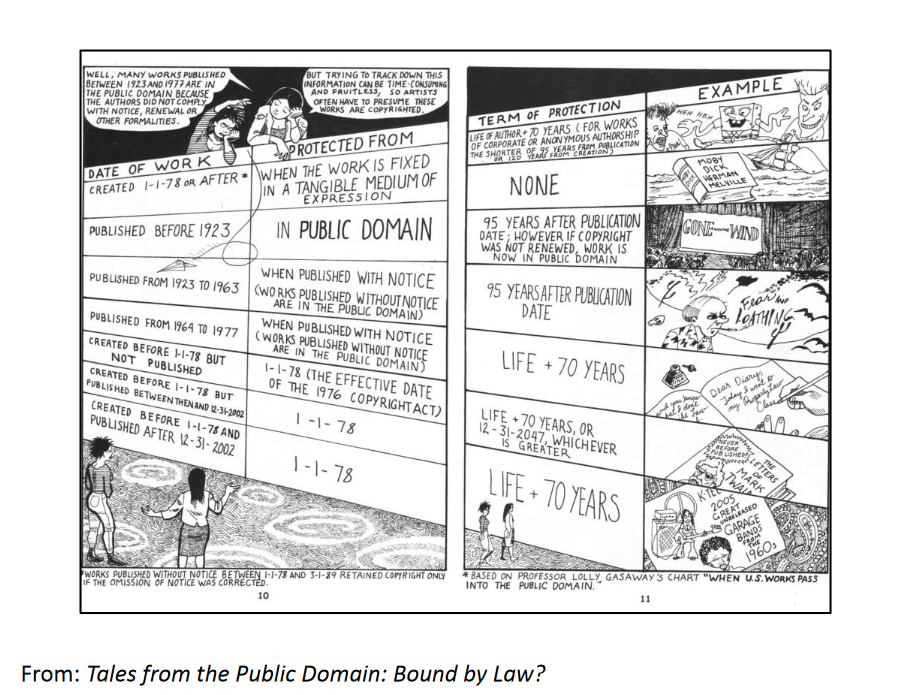
When institutions digitize special collections one main concern is who “owns” an item. Copyright refers to who has rightful ownership of an item. Copyright is governed by Title 17 of the United States Code, which states that, “copyright protection subsists, in accordance with this title, in original works of authorship fixed in any tangible medium of expression, now known or later developed, from which they can be perceived, reproduced, or otherwise communicated, either directly or with the aid of a machine or device”.
Jean Dryden, author of “The Role of Copyright in Selection for Digitization” featured in the American Archivist magazine, states that copyright is seen as a “limitation on access to cultural heritage, especially in the digital environment” (65). In her article, Dryden describes how libraries have difficulty in dealing with copyright issues because ownership is not always known for items; seeking permission for known or unknown owners is time-consuming and sometimes continues to be unresolved or denied; and informational professionals may not have the necessary legal knowledge or background and/or may not have access to legal counsel to interpret copyright law accurately or to deal with copyright claims or challenges (65-66).
Some institutions include disclaimers with their collections. The New York Public Library includes a statement saying the library “actively review[s] and label[s] materials in Digital Collections with statements that indicate how you may reuse items, and what sort of permission, if any you need to do so” (2020). The Digital Public Library Association (DPLA) states that “the copyright status of items in DPLA varies…many are in the public domain, while others are under rights restrictions but nonetheless publicly viewable. For individual rights information…check the ‘Rights’ field in the metadata or…the content provider’s website…” (2020).
While the digital world expands, advocates are actively working to help inform informational professionals about copyright and to work toward having copyright laws that allow libraries to utilize digital collections to help educate, preserve history, share culture, and so on. One such advocate is the Library Copyright Alliance. The Association of Research Libraries, the American Library Association and the Association of College and Research Libraries “address copyright issues that affect libraries and their users” (Association of Research Libraries).
In the meantime, institutions may continue to do the best they can regarding copyright. They may do a case-by-case evaluation for copyright issues; they may move forward with using items with unknown origin despite the effort required to track down and obtain permission; they may use a “risk assessment approach” to decide to use or not use an item based on the likelihood of a challenge to ownership; they may attempt to determine if an item may fall under a “fair use” exception; or they may simply not use an item because ownership cannot be determined.
 INF 6010: Special Collections in the Digital Age